About Commonwealth Shared Scholarships 2027
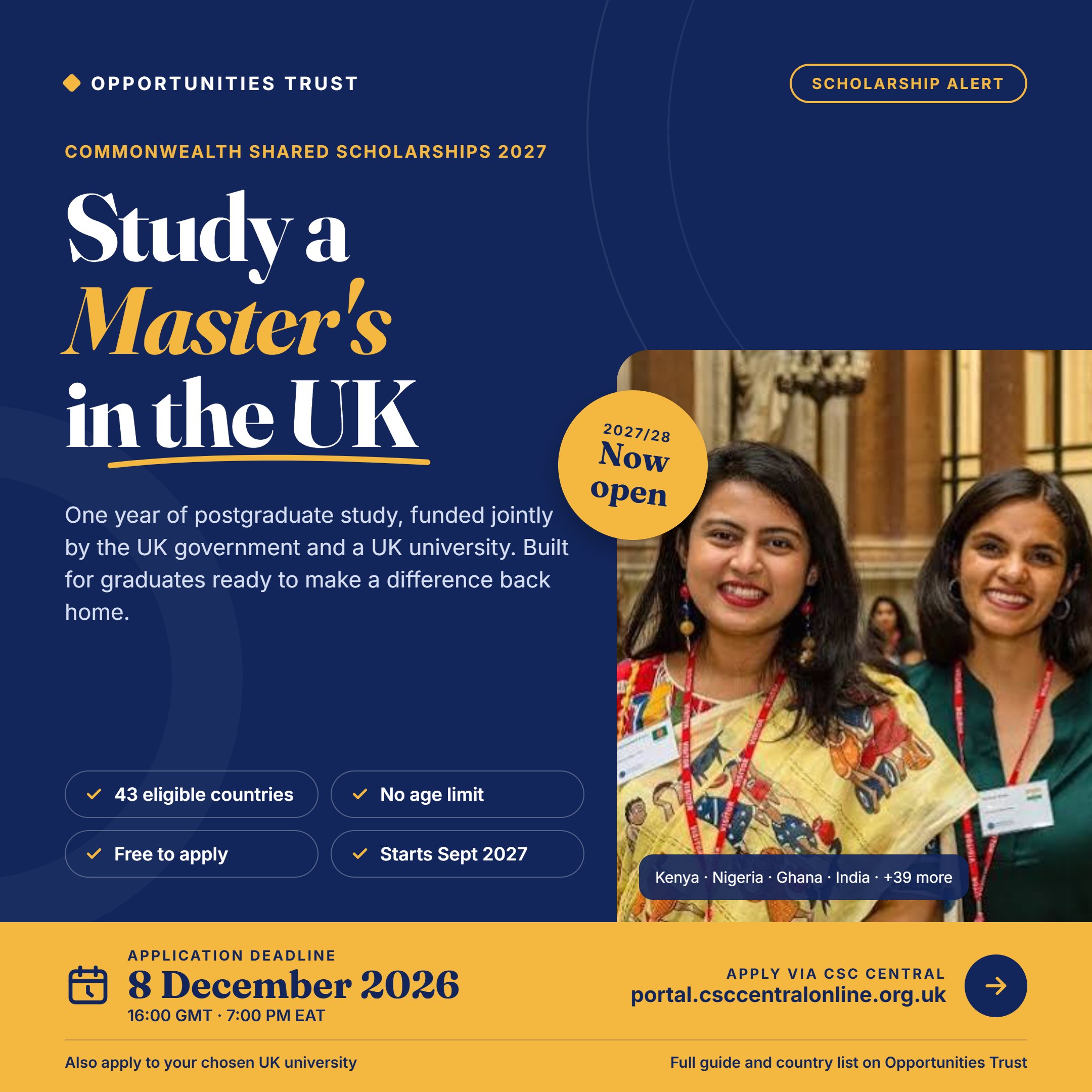
Commonwealth Shared Scholarships give talented graduates from lower and middle-income Commonwealth countries the chance to do a one-year Master’s degree in the UK, funded jointly by the UK government and a UK university. Applications for the 2027/28 intake are now open, and courses start in September or October 2027.
The Commonwealth Scholarship Commission in the UK (CSC) runs the programme as part of the UK government’s Commonwealth scholarship scheme, which focuses on international development. It looks for capable people who couldn’t otherwise afford to study in the UK, then supports them to return home and use what they’ve learned in their country’s development.
The funding is “shared” because UK universities bid for scholarships on specific Master’s courses that support development, and they agree to pay the living-cost part of each award. So you don’t just apply to the CSC. You apply for an approved course at one of the participating universities.
Eligibility
Commonwealth Shared Scholarships have strict eligibility rules, and the CSC checks every nominated candidate against them. To qualify, you must:
- Be a citizen of, or have refugee status in, an eligible Commonwealth country
- Live permanently in an eligible Commonwealth country
- Be able to start your studies in the UK by September 2027
- Hold, by September 2027, at least an upper second-class (2:1) first degree, or a lower second-class degree plus a relevant postgraduate qualification, usually a Master’s
- Not have studied or worked for a year or more in a high-income country
- Be unable to afford UK study without this scholarship
- Submit all required documents in the correct format
If you’ve studied by distance learning with a university in a high-income country while living at home, that’s allowed. Just say so clearly on the form.
Who Can Apply?
The scholarship suits people who already work in, or plan to work in, an area that matters to their country’s development. A public health officer who wants to study epidemiology, an engineer working on water systems, or a teacher interested in education policy would all fit well.
There’s no age limit. If you’re employed, though, check whether your employer has any age rules on study leave.
You can also apply while you’re still finishing your first degree. Enter your expected completion date and upload your transcripts so far. The degree must be finished by September 2027.
The programme only covers Master’s degrees. If you’re looking for undergraduate or PhD funding, you’ll need to look at other scholarships.
Eligible Countries
Only citizens or refugees of the following 43 countries can apply:
Africa: Botswana, Eswatini, Gabon, Ghana, Kenya, Lesotho, Malawi, Mauritius, Mozambique, Namibia, Nigeria, Rwanda, Sierra Leone, South Africa, Tanzania, The Gambia, Togo, Uganda, Zambia
Asia: Bangladesh, India, Malaysia, Maldives, Pakistan, Sri Lanka
Caribbean, Americas and Atlantic: Belize, Dominica, Grenada, Guyana, Jamaica, Montserrat, Saint Helena, Saint Lucia, Saint Vincent and the Grenadines
Pacific: Fiji, Kiribati, Nauru, Papua New Guinea, Samoa, Solomon Islands, Tonga, Tuvalu, Vanuatu
If your country isn’t on this list, you can’t apply for this programme. You may still qualify for other CSC awards, or for scholarships offered directly by UK universities.
Application Process
You need to apply in two places: to the university for a place on the course, and to the CSC for the scholarship.
- Pick your course. Browse the approved courses list and check the participating universities. You can apply for more than one course and university, but you can only accept one scholarship offer.
- Apply for admission. Apply to the university for a place on the course itself. Each university has its own entry requirements and dates, so contact them directly.
- Apply for the scholarship. Fill in your application on CSC Central. The CSC doesn’t accept applications any other way. Registration uses two-factor authentication, so you’ll need a smartphone or a second email account.
- Write your answers offline first. The form asks about your award objectives, your career plans for the next five years and beyond, a detailed study plan, a personal statement, and your volunteering and leadership experience. Draft these in a document, then paste them in. The CSC provides a template form and a guidance document to help.
- Submit and wait. Universities pick their candidates and nominate them to the CSC in March 2027. The CSC then confirms that they’re eligible.
Candidates are judged on three things: their academic merit, the quality of their study plan, and how much their studies could help their home country develop. Show clearly how your answers meet each one.
A few practical tips:
- Save often.
- Don’t refresh your browser, or you’ll lose unsaved work.
- Use the form’s own back buttons, not your browser’s.
- Check everything before you submit, because you can’t make changes afterwards.
- Keep the email with your application reference and passcode. You’ll need both to log back in, and they’re case sensitive.
Required Documents
Your application will be ruled ineligible if any of these are missing by the deadline:
- Proof of citizenship or refugee status: a valid passport or national ID card showing your photo, date of birth and nationality
- Full transcripts for every higher education qualification, covering all years of study, with certified English translations where needed. If you have a Master’s degree, include both your undergraduate and Master’s transcripts.
- At least two references in PDF format, signed, and either on institutional letterhead or sent as an email that clearly shows who the referee is
You collect the references yourself and upload them to CSC Central. They can’t be sent any other way, or after the deadline. Ask your referees to explain, in their own words, how long they’ve known you, how well you think and solve problems, how determined you are, your strengths and weaknesses, and the difference you could make at home. If you’re working, one of the referees you name on the form must be your current employer.
FAQ
Do I need IELTS to apply?
Not for the CSC application. However, your chosen university may ask for an English test, so check with them.
Can I use an offer for the current academic year?
No. You can only apply for the next academic year. Some universities may agree to defer your offer, so it’s worth asking.
Does it cost anything to apply?
No. The CSC doesn’t charge an application fee.
What if my transcripts are incomplete?
Missing pages make your application ineligible. Upload every page from every year of study.
Can I save a copy of my application?
Yes. Print the summary page when you submit, or log in later and choose “view a submitted application.”
Deadline
Commonwealth Shared Scholarships applications for 2027/28 close at 16:00 GMT on Tuesday, 8 December 2026. Late applications won’t be considered, and neither will documents sent outside CSC Central.