Overview: AI for Good: Humanitarian Challenge
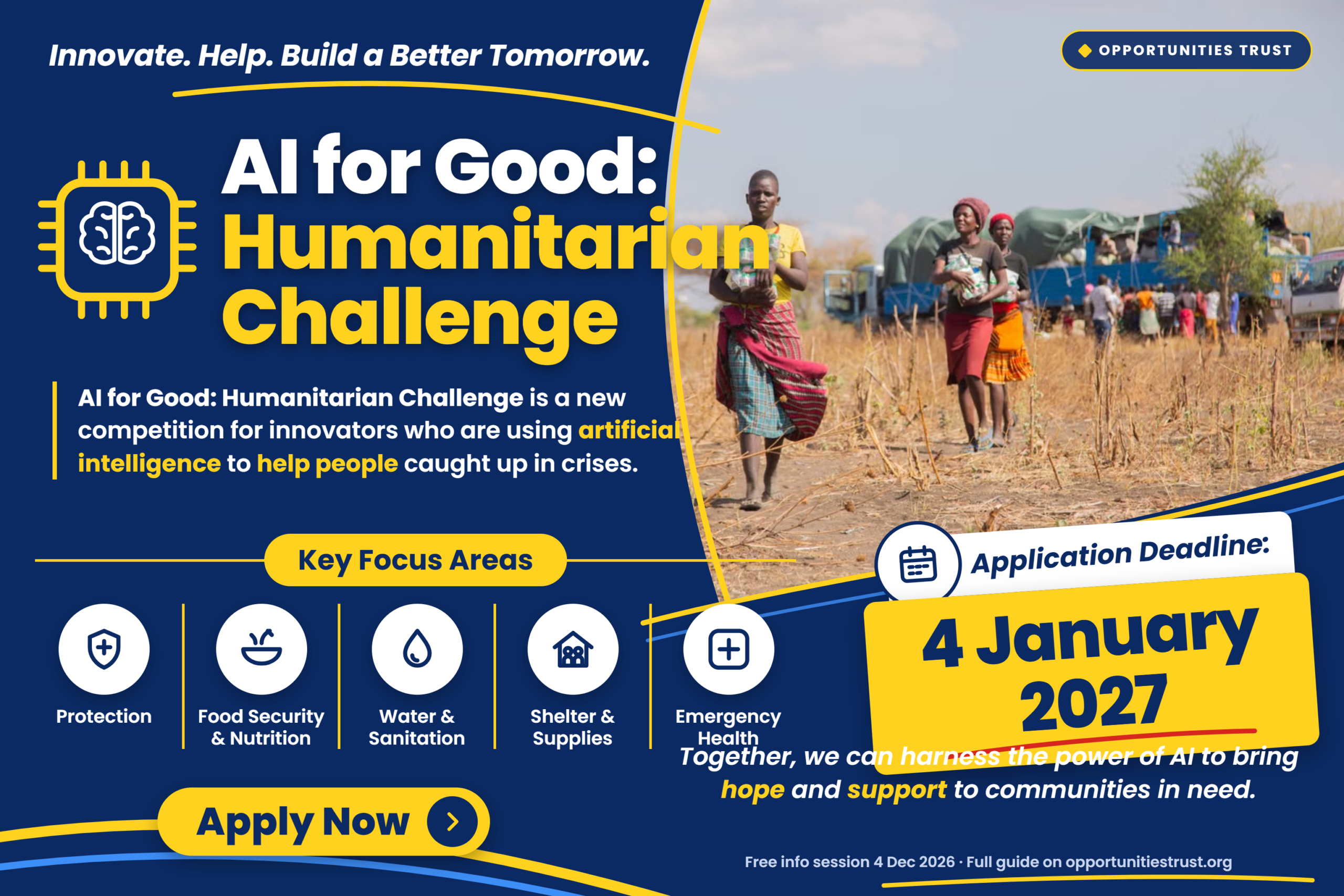
AI for Good: Humanitarian Challenge is a new competition for innovators who are using artificial intelligence to help people caught up in crises. It’s the first AI innovation competition run by the Spirit of St. Louis AI Innovation Center in the United States, and it’s administered by GeoSTL.
The aim is to take humanitarian projects that already show promise and give them the computing power, AI tools and expert advice they need to grow. If you’re working on something that could help people survive a flood, find clean water or reach medical care during an emergency, this competition is worth a serious look.
Some of the biggest names in technology are behind it. The Center’s founding technology partners are Amazon Web Services (AWS), Google, NVIDIA, Overture Maps Foundation, WEKA and World Wide Technology.
Applications opened on 18 November 2026 and close on 4 January 2027, so there are only a few weeks to prepare.
About the Challenge
AI for Good: Humanitarian Challenge is built on a practical observation. People who work in humanitarian response understand the problems communities face during wars, disasters and other emergencies. Researchers, entrepreneurs and engineers often have ideas that could help. This competition brings the two together and adds serious AI resources to move the best ideas forward.
To take part, you need to pick a specific humanitarian problem and explain how AI and computing resources could help solve it or help an existing solution reach more people. You also need to show who would benefit.
The competition uses the definition of humanitarian work set out by the UN Office for the Coordination of Humanitarian Affairs (OCHA). In plain terms, that means work that protects life and health, eases suffering and protects people’s dignity during crises such as armed conflict and natural disasters.
Both new ideas and existing projects can apply. A new approach needs a working proof of concept, while an existing effort should be ready to expand.
Category of Humanitarian Challenges
AI for Good: Humanitarian Challenge doesn’t split entries into separate tracks. Instead, the organisers give five example areas, based on OCHA’s view of humanitarian needs, to show the kind of problems they have in mind:
- Protection: keeping people affected by conflict and disasters safe
- Food security and nutrition: making sure people have enough to eat during crises
- Water, sanitation and hygiene: clean water, safe toilets and disease prevention
- Shelter and essential supplies: getting people housing and the basics they need
- Emergency health services: delivering medical care when systems are under pressure
These areas are examples, not a complete list. If your project tackles a different humanitarian problem that fits the overall purpose, you can still apply.
Projects can use any relevant AI method. Satellite imagery, Earth observation and mapping data are welcome where they help, but they aren’t required.
Who Can Apply?
The competition is open to:
- Researchers and university teams
- Entrepreneurs and startups
- Small businesses
- Technology innovators
- Teams building or scaling humanitarian solutions
Your background matters less than having a clear humanitarian problem and a believable plan for using AI to tackle it.
There’s one technical requirement. Your project must be at Technology Readiness Level 3 (TRL 3) or above. That means you’ve already shown an early proof of concept that works. So if your project is still only an idea, it isn’t eligible yet.
The published guidelines don’t mention any country restrictions. They don’t say the competition is open worldwide, but they don’t limit it to the US either. If you’re applying from Africa or elsewhere outside the US, it’s worth confirming with the organisers before you put in the work.
What Does the Winner Receive?
Five finalists will be invited to pitch their projects, and one winner will receive a support package tailored to what their project needs. This could include:
- Computing power: cloud credits, high-performance computing capacity and access to GPUs
- AI tools and data: AI models, development tools and open geospatial data
- Expert support: guidance from specialists, training and help with project development
The exact package depends on the winning project and on what the technology partners choose to offer. Each partner decides which projects it wants to back.
There’s no cash prize. This is in-kind support, which means resources and expertise rather than money. For many AI projects, though, computing power and expert help are exactly what’s holding them back, and they can cost a great deal to buy.
Winners also keep ownership of their intellectual property, which matters a lot for startups and research teams.
Application Process
The organisers want proposals that are specific and easy to follow. Here’s how to approach yours:
- Choose one specific problem. Avoid broad goals like “improving disaster response.” Pick a real, defined problem that affects real people in a crisis.
- Say who benefits. Describe the people your project would help and how their situation would improve.
- Explain the role of AI. Show exactly how AI and computing resources would help solve the problem or expand your existing work.
- Show your progress. Share evidence of your proof of concept, such as results, a prototype, pilot data or early users.
- Explain what the support would change. Describe how computing credits, tools or expert guidance would help you build or scale your solution.
- Join the info session. GeoSTL is running a one-hour live session on 4 December 2026 with an overview of the competition, a walkthrough of the application form, and a Q&A. Registrants receive the link the day before.
- Submit your application before the deadline: [INSERT APPLICATION LINK]
The organisers give two examples of a strong project. One team might use satellite data to give communities earlier warning before a flood. Another might combine clinic records and weather data to map where cholera is likely to spread. Both examples are narrow and concrete: one risk, one group of people and a clear use of data.
Key Dates
- 18 November 2026: Applications open
- 4 December 2026: Information session (10 a.m. US Central Time, which is 7 p.m. East Africa Time)
- 4 January 2027: Applications close
- 6–24 January 2027: Expert review
- 29 January–1 February 2027: Five finalists notified
- 18 February 2027: Pitch day
- 26 February 2027: Winner notified
- March–June 2027: Project development
The organisers say these dates could change, so check the official page from time to time. Project work begins once contracts are signed and runs until June 2027.
FAQ
Is there a cash prize?
No. The winner receives computing resources, AI tools and expert support, not money.
Does my project have to use geospatial or satellite data?
No. Geospatial methods are welcome where they fit, but the focus is on the humanitarian problem and how AI can help solve it.
Are the five humanitarian areas separate categories?
No. They’re examples to show the scope of the competition. You don’t need to choose one.
What does TRL 3 mean?
Technology Readiness Level 3 means you’ve already shown that your idea works at a basic level through an early proof of concept. That’s the minimum for this competition.
How is the winner chosen?
A panel of judges reviews all applications and picks five finalists. They present their projects on pitch day, and one winner is chosen.
Who owns the project if I win?
You do. Innovators keep ownership of their intellectual property.
Can I apply from outside the United States?
The guidelines don’t mention any country restrictions, but it’s best to confirm with the organisers before applying.
Is there a separate opportunity for experts?
Yes. The organisers are also looking for judges with experience in humanitarian response, AI or geospatial technology.
Deadline
AI for Good: Humanitarian Challenge applications close on 4 January 2027.
With the holiday season in between, that’s less time than it looks. If you plan to apply, start now. Write down your problem statement, gather evidence of your proof of concept, and sign up for the 4 December info session so you can ask questions directly.